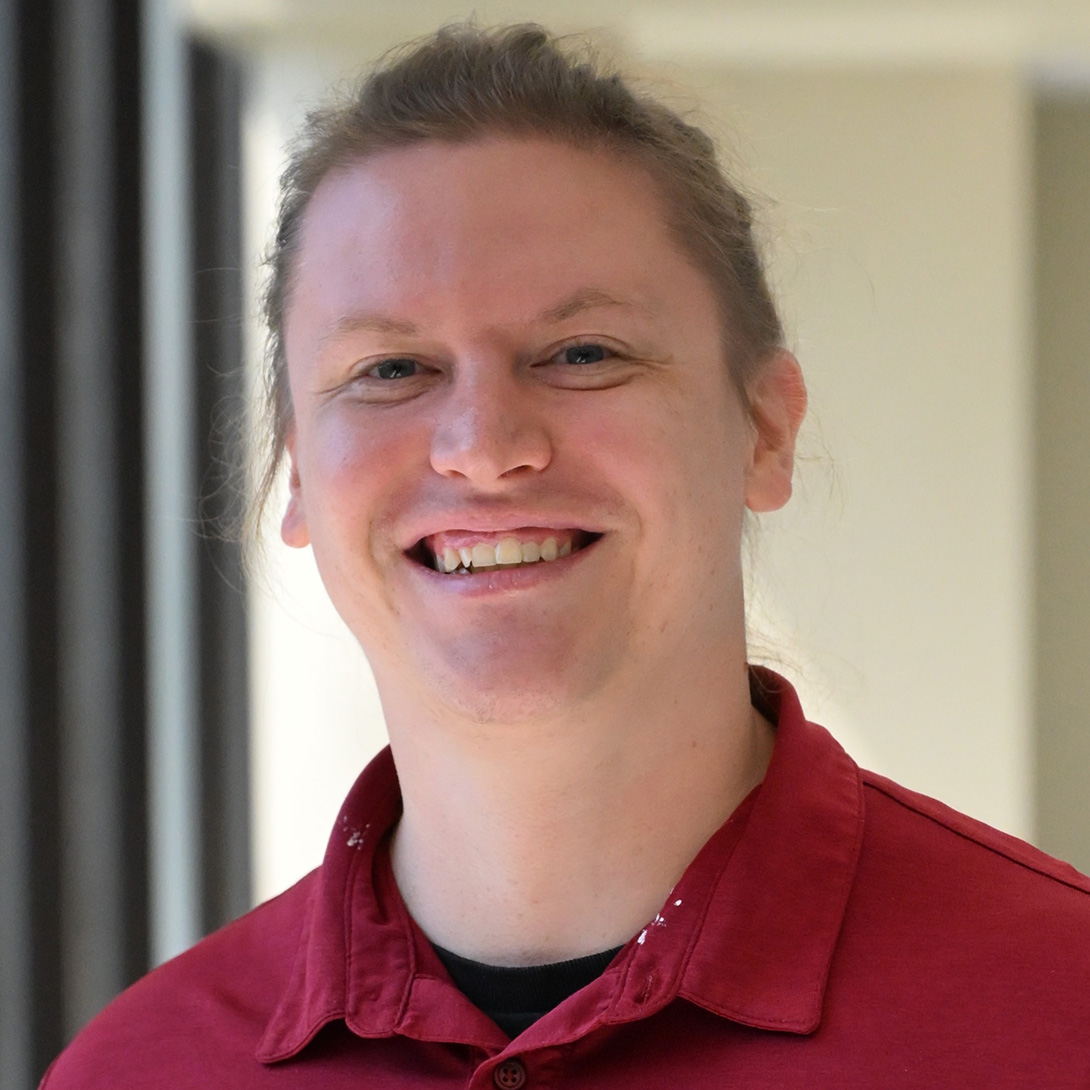
Adam Cook, Ph.D.
Assistant Professor
Oliver 3045
organic synthesis
bioorthogonal catalysis
drug delivery
Education
- Banting Postdoctoral Fellow, Stanford University, 2024-2026
- Ph.D., University of Ottawa, 2024
- B.S., Ontario Tech University, 2017
Research Interests
The next frontier in chemical discovery lies in making molecules with precision, purpose and control, directly where they are needed. Research on the Cook Team places synthetic organic chemistry at the heart of delivery science as we develop new catalysts and reactivity to enable the transport of small molecules, nucleic acids and organometallic catalysts across biological barriers. Currently, we leverage our expertise in organic and inorganic chemistry, chemical engineering, chemical biology and antibody engineering to create catalytic drug factories that operate selectively at the site of disease, enabling therapeutic interventions such as the on-tumour synthesis of chemotherapeutics.
Delivery is inherently disease-agnostic: whether therapeutic, prophylactic or diagnostic, its success hinges on the synthesis of biocompatible vehicles that achieve efficient and selective delivery into biological environments. Our research is guided by the hypothesis that mechanistically rational catalysts, lipid architectures and chemical-biological conjugates can be designed to overcome delivery barriers including biological instability, poor selectivity and limited intracellular access. Critically, each of our research directions are aimed at addressing unmet clinical needs in cancer therapy, neurological disorders, organ-specific disease and cellular rejuvenation.
In our lab, high-throughput experimentation (HTE) and sustainable catalysis underpin the discovery and development of new chemistry towards the development of delivery systems capable of addressing critical global challenges. As society enters the age of personalized medicine, achieving precise control over the structures and spatiotemporal release of bioactive agents is paramount.
Select Publications
Cook, A.; Kassymbek, A.; Vaezghaemi, A.; Barbery, C.; Newman, S. G. An S N 1-approach to cross- coupling: Deoxygenative arylation facilitated by the β-silicon effect. J. Am. Chem. Soc. 2024, 146, 19929–19938.
Highlighted in Synfacts (10.1055/s-0043-1775100)
Highlighted in OPRD (10.1021/acs.oprd.4c00352)
Cook, A.; Newman, S. G. Alcohols as Substrates in Transition-Metal-Catalyzed Arylation, Alkylation and Related Reactions. Chem. Rev. 2024, 124, 6078–6144
Cook, A.; St. Onge, P.; Newman, S. G. Deoxygenative Suzuki-Miyaura Arylation of Tertiary Alcohols through Silyl Ethers. Nature Synthesis, 2023, 2, 663–669.
Highlighted in Synform (10.1055/s-0040-1720618)
Cook, A.; MacLean, H.; St. Onge, P.; Newman, S. G. Nickel-Catalyzed Reductive Deoxygenation of Diverse C–O Bond Bearing Species. ACS Catal., 2021, 11, 13337–13347.
Cook, A.; Clement, R.; Newman, S. G. Reaction Screening in Multiwell Plates: High-Throughput Optimization of a Buchwald-Hartwig Amination. Nature Protocols 2021, 16, 1152–1169.
Cook, A.; Prakash, S.; Zheng, Y. -L.; Newman, S. G. Exhaustive Reduction of Esters Enabled by Nickel Catalysis. J. Am. Chem. Soc. 2020, 142, 8109–8115.
Highlighted in ChemistryViews
Courses
- CHEM-301: Organic Chemistry I
Awards
- Participant, 74th Lindau Nobel Laureates Meeting, 2025
- CCUCC Chemistry Doctoral Award, 2025
- Banting Postdoctoral Fellowship, 2024
- NSERC Alexander Graham Bell Canadian Graduate Scholarship, 2021